The best periodic table games in 2026
The periodic table looks like a wall of trivia until someone shows a kid the pattern hiding in it — rows fill, columns behave alike, position predicts personality. The best periodic table games teach the pattern, not the flashcards.
The periodic table overwhelms children when it is presented as 118 separate names and symbols. Its real power is organizational: atomic number sets the order, periods reflect filling electron levels, and groups collect elements with related behavior. Students commonly assume atomic mass determines position or that neighboring boxes must behave alike. The table begins to click in middle school when kids use an element’s location to make a reasonable prediction, then see that the layout carries information they did not memorize.
A worthwhile periodic table game turns the table into evidence, not a backdrop for flashcards. Look for unknown elements to test, patterns across rows and columns, and predictions about reactivity, conductivity, or state before the identity appears. Symbol recall has a place, but it should follow repeated use. Weak games award speed for matching Na to sodium. Strong games make a child compare properties, revise a placement, and explain why an element belongs with a family rather than simply where a clue told them to drop it.
Keep play to fifteen or twenty minutes and focus on one pattern, such as metals versus nonmetals or one element family. Ask, “What could you predict from this box without knowing the element’s name?” and “Which evidence changed your mind?” For a kitchen-table extension, collect labels from salt, aluminum foil, a pencil, and a helium balloon picture. Find the main elements involved, locate them on a printed table, and compare what their positions do and do not tell you.
Top picks for 2026
1. Element Lab
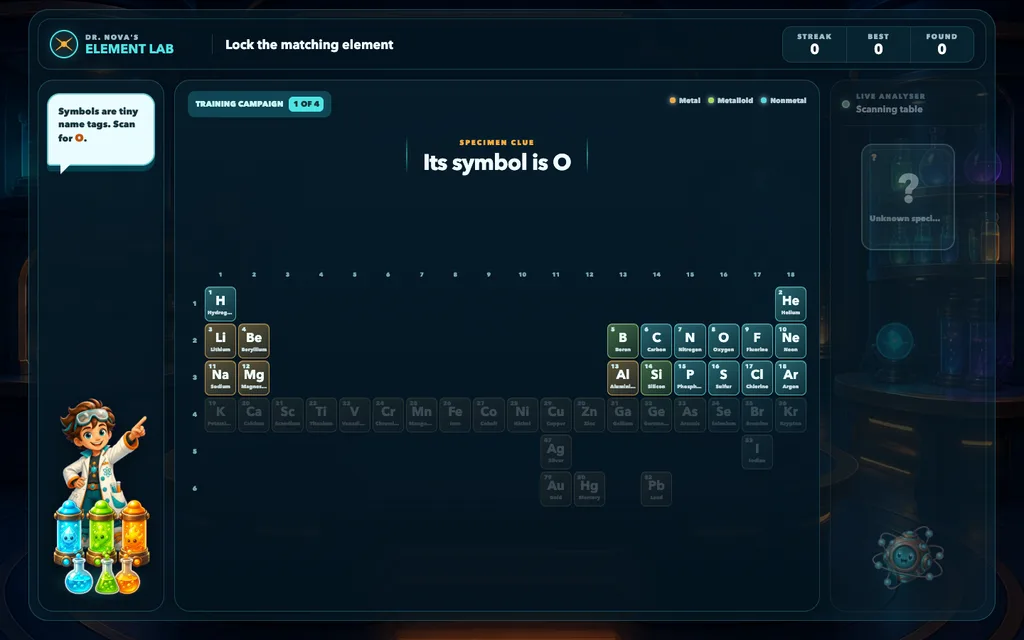
Element Lab hands your child unknown elements and a working analyser: test reactivity, check conductivity, weigh it, then place it where the evidence says it belongs. The table assembles itself from their deductions. Ako, the voice AI tutor, plays lab partner. Ages 10–13, first lesson free.
Common questions
What age do kids learn the periodic table?
First exposure usually comes in middle school (ages 11–13), with the deeper group-and-period logic in early high school chemistry.
Should kids memorize the periodic table?
No — chemists don't. Understanding why the table is shaped the way it is beats reciting it. Memorizing the first 20 elements happens naturally through use.
Is Element Lab free?
First lesson free in the browser, no account. A subscription unlocks the full Ako catalog including Atom Builder and Reaction Balancer.